



Bright morning light beamed through the windows in Mayor Chokwe Antar Lumumba’s meeting space that connects to his office on the third floor of Jackson City Hall. It was the kind of sunshine that creates a glare, posing an issue for the mayor on July 5—he needed to get the best view of his father in archival footage from the Mississippi Department of Archives and History. The son and other chief administrators were meeting with a campaign supporter, Dominic DeLeo, who had brought clips to share following a meeting about the “One Lake” proposal.
“That’s my dad!” The mayor yelled out, as the late Chokwe Lumumba emerged on the screen, slender and consumed by a well-rounded afro. The mayor’s driver, Ervin Bradley, who goes by Hondo, got up to close the blinds. As everyone around the table swiveled the chairs to face the screen, the room fell silent, mainly because the volume on this footage was so low.
The video came from Land Celebration Day, which took place in Bolton in western Hinds County back in 1971.
The event represented a benchmark in the Republic of New Afrika‘s plan to create independent black communities in the Deep South. The plan was for Mississippi to be an anchor, considering its potential to become a black empowerment zone. The hope was that black people from everywhere would come here as refugees of racism, white supremacy and poverty.
Law enforcement on every level grew concerned about the celebration set for March 1971. State, county and federal officials raided RNA member’s homes and arrested them for being armed, as they almost always were. At the same time, musicians and other invited guests declined to attend the land celebration.
However, then-Bolton City Councilman Bennie Thompson and state Rep. Robert Clark, Mississippi’s first black legislator since Reconstruction, spoke out against the police interference in defense of the RNA, reads Akinyele Omowale Umoja’s 2013 book “We Will Shoot Back: Armed Resistance in the Mississippi Freedom Movement.”
“This is where the term ‘Free the Land’ comes from,” the mayor said as he watched the video. Chief of Staff Safiya Omari and Lumumba shouted out names of the various RNA members they recognized on the screen such as Alajo Adegbalola, whom Omari and Lumumba called referred to as just “Brother Alajo.”
The mayor’s eyes lit up, in awe of how young his father looked, a man he said he does not recall without gray hair. The elder Lumumba was in his early 20s then, wearing a black turtleneck and black jacket.
“It’s funny, you look just like him,” Jackson’s Chief Administrative Officer Robert Blaine said to his boss. Blaine also serves as the interim director of the Department of Finance since Charles Hatcher resigned the position at the end of May. Others around the room remarked that the father and son make the same gestures, as they both talk with their hands.
The mayor wanted to see footage of the barricade of law enforcement trying to prevent RNA members from having the land celebration. His father was head of security at that time, and he went to talk to the officers.
“My dad’s words to them were: If there’s going to be bloodshed, it’s going to be on both sides, right? And that’s when he said it opened up like the Red Sea,” the mayor told his colleagues.
The late Lumumba captured the room through that television screen as he was known to do during his life. His principles, values and vision cemented a world-renowned legacy that his namesake most closely adopted. But, this mayor also wants to make a name for himself.
“I feel I always reflect back on my dad because he was my hero, but I feel comfortable being me,” the mayor told the Jackson Free Press. “So it’s a path that he led me on, but it’s my own walk.”
Scratching the Surface
Jackson’s youngest mayor, now 35, assumed his official duties on July 3, 2017, and since then, he has been on a determined-but-rocky mission, as the world looks on. The mayor knows that his popularity stems from who his parents were, but also who the nation is in this moment.
“I think also our willingness to embrace radical instead of running away from it is something that the country is kind of in this curious space where, whether you’re considered far-left or far-right, we’re exploring change,” Lumumba said sitting in a wheeled office chair in the same place he watched footage of his dad earlier.

Omari has served as the chief of staff for both Lumumbas. She is careful about comparing the two.
“Chokwe Sr. was very thoughtful and deliberate,” she told the Jackson Free Press. “But I can’t say that without it seeming like he’s not,” Omari added, gesturing toward the mayor’s office down the hall.
“He’s also thoughtful and deliberate, but in a different way.”
Omari finds things more fast-paced in this era, and although both men had the same vision, she says the elder Lumumba had a council that was willing to work really closely with him. Now she finds more resistance.
“With this council, I think Antar had some big shoes to fill just really based on the name,” she said.
City Council Vice President Virgi Lindsay of Ward 7 has been critical of council decorum in her first year in the role, and hopes to get more efficient.
“I’ve come to realize that we all are very committed to the City, and really at the end of the day we all are motivated by our desire to see a better City. But, do I wish we could have the one-hour power meeting? You bet,” she said in an interview.
In this next year, and after a number of open clashes with the council over late-hour requests and the thinly stretched budget, Omari wants to step into the role of facilitating communication early on with the council so that the administration can hash out everything before things go on the agenda. However, newly minted Council President Melvin Priester Jr. feels immune to the back-and-forth in meetings because he’s a lawyer by trade, but he also finds them necessary for transparency’s sake.
“[P]eople all the time say you should have the meeting before the meeting, but that goes against the spirit of the Open Meetings Act,” Priester said in a phone interview. “So a certain amount of this stuff does have to occur publicly.”
After five years on the city council, Priester has gotten used to how administrations spend the first year getting settled in, then year two and three implementing things so that city officials can show results in year four—the re-election year.
Although the mayor campaigned on taking a radical stance, Priester finds that municipal government should be boring, but if the goal is transformation, then capitalizing on technology and operations would be a game changer.
“From my end, effective technocratic government would be a radical accomplishment,” Priester said.
Omari now wonders if they’ve been radical enough. She paused, and then laughed after mulling that question over.
“The younger me would say, ‘nah, we haven’t been radical.’ But the older, more seasoned me would say ‘yeah, some of the things we’ve done have been,’” she said.
Avoiding the Jackson Public School District state takeover is one example that virtually everyone in City Hall agrees demonstrates not only the best day of the last year, but also one of the most radical things to happen in this administration. A few months after the mayor took office, he and his advisers reached an unexpected compromise with conservative Gov. Phil Bryant to keep the school district in local control.
The new deal meant the past school board had to resign, and the mayor had to appoint a brand new one. Blaine praises the new board, especially President Jeanne Hairston for her leadership. But, the board is still short one member, whom Blaine says should be confirmed this summer. Omari feels like this bipartisan workaround really put Lumumba on the map.
“People talk about the national exposure that he has and all the places that he’s invited to speak … but a lot of that came out of the fact that he was bold enough to expend political capital to step out there and say, ‘I’m going to work with this conservative governor to save our schools because our kids are what matters,’” she said.
Bobbing, Weaving in Crisis
City Hall, the edifice, is sturdy. Slaves built it by hand in the 1840s, and it withstood the Civil War when Confederate and Union soldiers laid their heads in the hospital erected in the government building. Inside, however, Lumumba and his closest advisers, hailing primarily from academia, have had to get their hands dirty with proverbial bricklaying.
Following the school-district emergency, the City bobbed and weaved through a winter water crisis, the ever-looming consent decree with the Environmental Protection Agency over wastewater handling, and constant calls about insurmountable Siemens Inc. water bills past administrations have dealt with too. Additionally, Lumumba has had three police chiefs, a rising homicide count including multiple lethal officer-involved shootings, and the death of a local high school girl due to City negligence.
In almost every one of these situations, including Frances Fortner’s death, the City lacked the necessary protocols in place to respond effectively or to prevent such tragedies in the first place. The mayor said he realized the City’s foundation was “far worse than even anticipated.”
Radicalness has a less common definition: forming a basis or foundation. As constituents took campaign signs out of their yards and Lumumba and his appointees settled in, the administration had to apply their radical vision to structuring the city’s government. Still, Lumumba thinks they’re moving at the necessary pace to develop long-term change.
“Sometimes I realize that a lot of what we’ve been dealing with in our first year—there have been some radical things here and there—but to me they seem very basic and standard. But we’re only scratching the surface right now,” he said.
Owning a Fatal Failure
The day before Frances Fortner, 18, was set to graduate from Jackson Academy was one of the first sweltering days in the City. People had just begun to reintroduce open-toe shoes for the season, and businessmen rolled up the sleeves of their button-ups or traded them for polos all together. It was officially the season for riding with the windows down, or, if possible, with the top off altogether.
Fortner cruised down Ridgewood Road around noon on May 17 in her mother’s red convertible, her similarly colored hair probably tousling in the wind as she drove to meet her peers for graduation rehearsal. She went over an unsecured manhole, and her car did a 180-degree flip. Fortner was pronounced dead at an area hospital. Jacksonians shuddered.
Mayor Lumumba got word almost immediately. He was on the scene that afternoon with members of his security detail. Jackson’s first lady, Ebony Lumumba, said she called to check on him because she knows how personally he feels these types of things, especially as a parent.
“Heartbreaking isn’t a strong enough of a tone for what that felt like…,” Ebony said in a phone interview as the newest addition, Nubia, slept on her chest. “My husband is not a stranger to loss, and tragic loss at that, so that’s what I mean when I know how these types of things affect him.”
Ebony said their conversation focused on how to cater to the emotional well-being of the Fortner family. Four days later, the mayor took responsibility on behalf of the City for the incident that led to Fortner’s death. “I feel that it is my responsibility as mayor of this city to be honest to the Fortner family and to be honest to the citizens of Jackson and acknowledge that the City of Jackson failed to appropriately secure the site at the time that we learned that the manhole cover was not properly in place,” Lumumba said then.
Lumumba chose honesty, despite advisors urging him to choose another route.
“He received a lot of counsel against coming out and admitting that the City’s response was not what it should have been,” Omari said. “He listened to all the voices and he said, ‘Look y’all, my heart is telling me that this is what I have to do.’”
The mayor says the Fortner case was a personal test of his values.
“If I claim to be a radical mayor, and I claim we’re going to be a radical city, then we need to step away from the norms of finding every little way to avoid where we know we failed, and we have to be bold enough to even confront ourselves,” the mayor said.
As the mayor explained in the press conference following Fortner’s passing, Public Works is not a first-response department, but he still wants to get better equipped. The public-works director wants the same thing.
The perennially kind and professional Bob Miller, director of public works, who claims to like Monday mornings so much that he spends his Sunday evenings looking forward to the next day, said the Fortner death is a personal tragedy he and everyone involved will never quite get over. His nearly 37-year career in this business did not prepare him for that Thursday afternoon.
“I’ve had occasions to be exposed when there was serious injury or loss of life,” Miller said. “But that one, I expect, will grieve me for the rest of my life. It drives me to make sure that and all of the other possible risks don’t ever happen again.”
Kicking the Can
When Bob Miller listens, he furrows his brow, and he has a tell whenever he is about to respond: his head bows into a sharp nod or two. He responds to everyone methodically, be it a council member or a reporter, often elevating conversation a step further with context and an endearing anecdote. Still, Miller feels as though there is a better listener: Mayor Lumumba.
“He is perhaps the best listener I’ve ever known in my life,” Miller said. “He listens very, very attentively. And he carefully considers what you say. And frankly, as a lifelong municipal employee, having a boss that actually listens and cares, that’s a good thing.” Miller has been one of Lumumba’s most fundamental hires, and he almost didn’t take the job.
At first, Miller was willing to serve as an unpaid adviser because he was not looking to move from New Orleans where he served as deputy director of the Sewerage and Water Board in New Orleans for eight years. Still, Lumumba remained persistent, asking Miller to pray for him and his City, and promising to do the same in return.
Finally, Lumumba invited Miller to church at Free Christian Church. Miller says that if you ever want to take somebody’s measure, you take him to church to see how he interacts with his family, his minister and his God. He found himself impressed with the mayor.
“And this is going to sound a little corny, but I did not want to miss out,” Miller said in an interview.
Miller says Lumumba stays engaged in every aspect of running the public-works department. The two men steered the City through a $1.6-million water crisis during which “peanut-brittle pipes,” as Miller called them, burst at rapid rates, and water pressure plummeted in the unusually frigid temperatures.
At one point, 70 percent of schools had little to no water pressure. When students finally went back to school in mid-January after an extended winter break, they were met with hand sanitizer, sack lunches and portable restrooms.
Robert Blaine reflected on this crisis made worse by the City’s lack of standard operating procedures for such an emergency: no contracts in the till, no guidelines for what to do when water tanks lose pressure and no electronic map of the water system.
“Literally, we had people walking down the street to figure out where a valve was,” Blaine said. “None of those emergency-preparation pieces had been in place, and the fact that we had to improvise all of that was a huge challenge.”
Councilman Priester finds that Jackson is almost always in a state of emergency because of problems the last several administrations have had to deal with: stagnant or declining revenue, flat population growth, a federal consent decree.
“It’s just tough because things get kicked down the road proverbially because we don’t have money to deal with it,” Priester said in an interview. “I think the vision that the Lumumba administration, and particularly Dr. Blaine, have tried to craft is: Let’s use technology to change our processes, and, let’s actually make the investment necessary to do that with our limited resources.”
Now, Blaine and Miller are working on plans that include GIS mapping to get rid of the City’s reliance on paper maps. Also, Miller finally got the council to agree to keep contractors on retainer, especially with the crisis the City’s water and sewer system faces now. The administration has few in-house resources to tackle sewer-system failures and nearly 100 water-system breaks and leaks as of mid-June.
Miller had gone back to the drawing board a few times to tweak the contingency contracts to make the council more comfortable with the dollar amount and equal business opportunity requirements.
But, this time was dire: the EPA was watching. The mayor told the council that the administration would have to report the council’s decision about fixing the sewers to the EPA just two days after the meeting. So, he and Miller presented these contracts as an emergency item.
Aaron Banks of Ward 6 made it clear he would vote against this item because he wanted not only the EPA requirements in writing, but a list of projects the contractors would tackle. This forced a second council meeting the next day because emergency items require unanimous votes to pass. Miller provided the council a list then, and the item passed unanimously.
However, the delay worried the EPA. The mayor expects a warning letter from the U.S. Department of Justice.
In April, Miller and Blaine had a six-hour-long meeting with the regional EPA office in Atlanta about the consent decree. Blaine said the interaction was intense, but in the end, he said the EPA took Miller’s plan for how to deal with the federal regulations “word for word,” only asking that he include a timeline.
Blaine says the ultimate goal is to renegotiate a consent decree because the one on the table is far too expensive for Jackson.
In the face of the winter-water crisis, Miller had to delay tackling the Siemens Inc. water-meter issues. But, in late April he presented a contract “scope swap” to the council that uses $1.1 million already in the contract to pay Siemens’ contractors to fix the billing system by September and start collecting anywhere from $10 million to $20 million in revenue that the City failed to recoup in Miller’s tenure alone. Then, Miller wants them gone.
Nearly 20,000 customers got water to their homes without paying for it because they were “stranded in the system,” so if they did get a bill, it could be thousands of dollars because the meter readings have been arbitrary.
As of the first week of July, 9,000 customers have been billed for more than $8 million, and half those customers have begun making progress payments amounting to more than $900,000 in cash so far. Miller estimates that the City is halfway through the needed work, and the project is moving like clockwork, he says. To gauge that accurately, the council agreed to bring in West Monroe Partners, LLC, of Chicago to ensure Siemens is in full compliance in executing this contract amendment.
Priester said Miller and Blaine impress him, but he finds the administration organized in some parts, and imbalanced in others. The councilman related this year to a game of Jenga. In order to not collapse everything, the administration has had to be careful. But, to keep the pace of the game going, officials also have to get over what Priester calls “decision paralysis” and make crucial choices, while also keeping in mind how the pieces rely on each other.
Like a Jenga tower after a few rounds, there are holes in the administration, and the longer you stay in the game, the harder it gets.
“I think that the challenges that they actually found were different than the challenges that they expected to find,” Priester said. “That’s why we find ourselves a year into our administration, and we still don’t have a police chief.”
People-Oriented Policing
Following his morning duties at City Hall on June 5, the mayor got into the passenger’s seat of a black SUV, and his driver Hondo took him to Pearl’s Southern Cooking in south Jackson. Lumumba’s phone connected via Bluetooth with the car’s radio system and he scrolled through his music library looking for the right song.
North Carolina native J. Cole is the mayor’s favorite, but he afforded this superlative with a caveat: he doesn’t always like to listen to “conscious music.” He went through Drake’s new album “Scorpion” and listed his favorite songs; “Blue Tint” was among them.
Hondo whips through Jackson’s streets as though he is trying to set a record. Another car with the rest of the mayor’s security detail trailed closely, and the men communicated via walkie-talkie the entire route, joking about who will miss the exit this time. Whether the mayor is out to dinner with his wife or at a city council meeting, you will never see him without some combination of the protective tetrad.

Inside the restaurant, the men dished heaps of macaroni and cheese, yams, smothered and fried chicken, lima beans, green beans, turnip greens and various baked breads onto their plates.
As Hondo ate chicken and piled up the bones on a separate plate, the other men around the table joked about his age. Hondo went to Alcorn State University in the 1970s, and the men around the table wondered if he had used a horse and buggy to get back to Jackson. They erupted into laughter at each new joke, egging each other on, making the stakes higher for the next punchline.
“You see how they do me?” Hondo asked rhetorically in his raspy voice that always gives the impression he needs to clear his throat. “Write this stuff down.”
He laughed too, though, flashing a single capped tooth.
However, things have not been as jovial with the capital city’s protection arm, which still does not have a permanent leader. The mayor does not want to rush his decision on a permanent police chief, which he sees as the most critical one he faces, especially when he did not expect to have to do so.
“When I first came in office, my anticipation was that I had my chief—he was already there,” Lumumba said of now-retired Lee Vance, who left the post in December 2017 with rumors of differences of philosophy with the mayor.
Lumumba brought in Anthony Moore as the first interim chief in January. He was difficult to schedule interviews with and elusive at press conferences, where he often hesitated to step up to the podium. Although Moore brought a promising resume with an academic background in criminal justice and 34 years on the force, it is unclear if he will remain with the force in the future.
“I appreciate the service of Chief Moore, and as we have elevated all of the factors to be considered, there was a need to go in a different direction,” the mayor told the JFP. “That doesn’t mean that his efforts weren’t sincere, that doesn’t mean that he didn’t provide valuable contribution to our City.”
The new interim chief, James Davis, appointed June 28, is in many ways the antithesis to Moore, at least personality-wise. The mayor likes that Davis has a significant presence in the community.
Documents
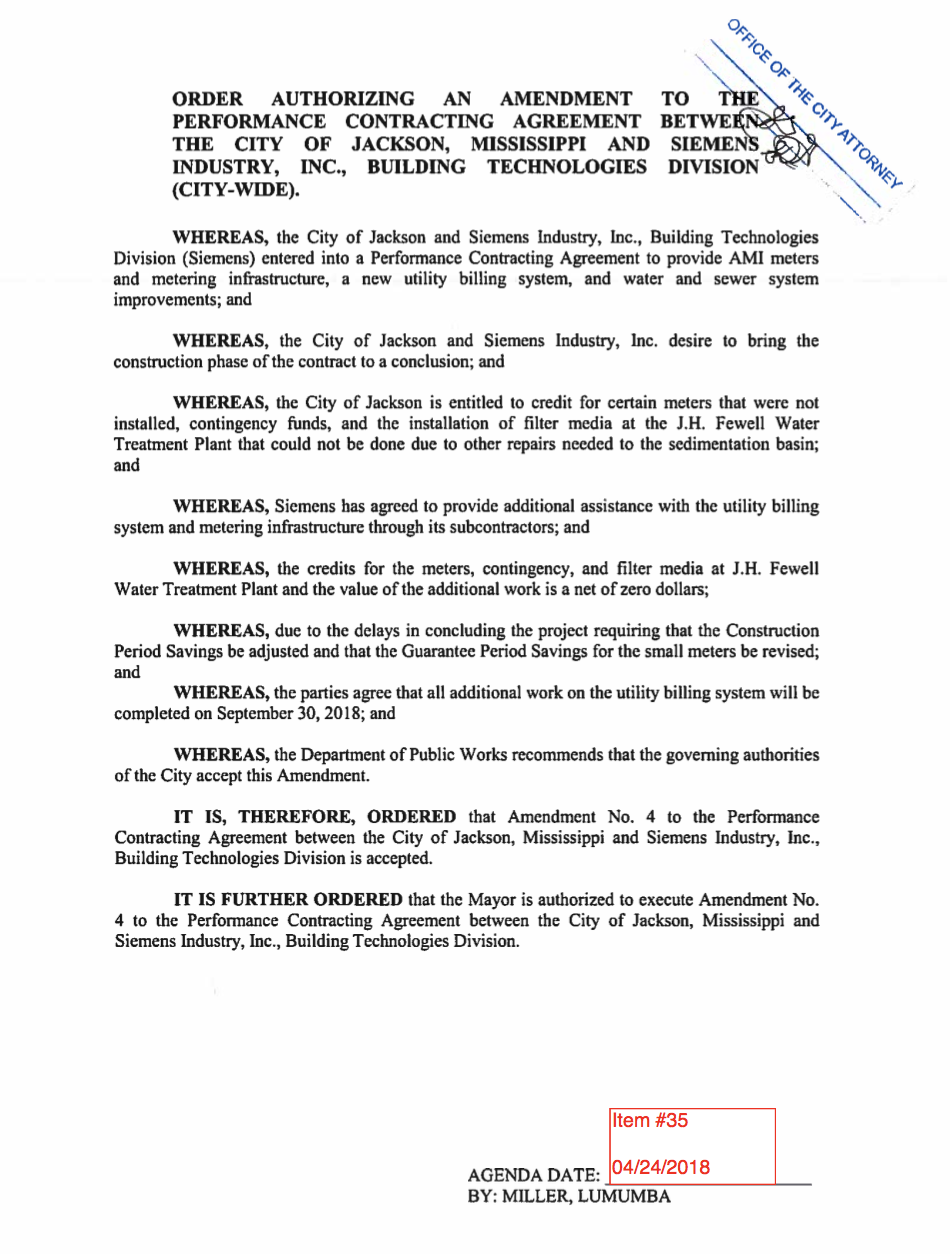
April 2018 Siemens Contract “Swap”
April 2018 Siemens Contract “Swap”