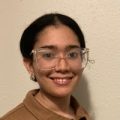
Sounded by paintings and art supplies, Daniela Gonzáles sat inside her Hattiesburg, Mississippi, apartment in January 2025 arranging photographs onto a blank canvas measuring 100-by-70 centimeters. As she fitted the images together, she contemplated composition and complementing colors, pairing a woman’s darker skin with lighter-colored flowers to sharpen the contrast.
Once the photos created an overall image that satisfied her, she set them down and picked up her brush to reproduce it in her own art style. She painted large, pink, dahlia-like blossoms around the woman’s face before tucking smaller violet flowers resembling cosmos between them and then extending leafy stems above the figure’s forehead and beneath her shoulders.
Gonzáles, who had just moved to Hattiesburg six months before, wondered how locals would receive her work. As she progressed, she questioned whether her vivid colors and defined planes would appeal to viewers whose tastes, she felt, leaned toward more traditional art styles. As she looked at the painting she would go on to name “Bloom,” she pondered, “Who is going to buy this?”
Finishing “Bloom” did not necessarily quiet those doubts. Gonzáles said she often begins finding faults in a completed work, picking out imperfections that others might not notice.Yet she kept returning to flowers. As a child, she had grown up with a patio full of plants that her grandmother and aunts tended with care. Female figures were equally familiar: Raised in a family made up mostly of women, she remembers drawing her grandmother as a girl when she was still a burgeoning artist.

Those subjects gave her something personal to build on in her adult life, even as she tried to understand an unfamiliar audience. Finding a place to show those paintings, however, meant navigating a community she was still getting to know. Gonzáles had moved to the city with her boyfriend from Barranquilla, Colombia, knowing few people and speaking little English.
“The fear of arriving in a new place, not knowing anyone, not speaking the language very well, that already creates a huge barrier for me,” she told the Mississippi Free Press.
She searched for exhibition opportunities, encountering galleries whose focus she described as “American art” and others that selected artists by invitation rather than through open calls. Still, she wanted to find a space that supported Latino artists. That search led her to Nuestro Arte, a gallery and cultural space on West 4th Street where vice president Jacqueline González Wooton welcomed her and explained how to submit works to the gallery.
“Finding Nuestro Arte was a blessing,” Gonzáles said. “They have been a great support for my career in this city and have opened many doors for me.”
‘Art is Educational, Too’
The opportunity Gonzáles found grew out of the founders’ own difficulty finding places to exhibit. For Wooton, President Hector Boldo, and Treasurer and Secretary Tom Boldo, creating Nuestro Arte meant making room for work that other venues had questioned or declined to display. The three founded the Mississippi Latinx Art Association in October 2023, hoping to connect with more Hispanic artists. As they searched for exhibition venues, some small venues and community spaces were unwilling to show certain pieces.
“Many of them, when they saw our art, would say, ‘Wow, you can do it, but you can’t have this painting. No, I don’t think the people who come here will like it,’” Wooton said.

Wooton’s paintings incorporated Catholic imagery, African religious references, nudity and symbols from different cultures. She said some venues worried about how audiences would respond. For her, those concerns raised a larger question about what viewers should expect from art.
“Art really isn’t always meant to make you feel good,” Wooton said. “Art is meant to make you feel something, whether it’s good or bad. It’s about what it makes you think and what it makes you feel. Art is educational, too.”
Rather than continue depending on venues that restricted what they could exhibit, the founders decided to establish their own space. That independence gave them a place to have conversations about the cultural meanings behind the work. Wooton said viewers sometimes misunderstood the religious imagery in her paintings, then reconsidered it after learning about the traditions represented.
“When they understand it, then well, ‘Oh, OK, I see,’ and then they can appreciate it a little more,” she said.
‘To Create a Little More Empathy’
For Gonzáles, too, there is history behind her imagery. She used photographs to develop compositions featuring plants commonly seen in Barranquilla. Through those images, she hopes to introduce viewers to the place and culture behind her work.
“I feel like Latino culture is often ignored,” Gonzáles said. “I want my work to help people understand where these images come from.”

Making Latino culture more visible was also a goal for co-founder Hector Boldo. Originally from Mexico City, he had lived in Austin and Phoenix before moving to Mississippi. In those cities, he recalled seeing murals and other public expressions of Latino culture. After moving to Mississippi, he noticed fewer visible signs of the community.
“It made me feel as though there weren’t enough Latinos, when in reality there were quite a lot,” he said. “There just wasn’t that representation.”
He began painting murals relating to Hispanic culture, hoping to make the community more visible. His experience as a migrant also influenced his paintings, including a series of large portraits depicting migrants who live and work in Hattiesburg.
“I wanted people to see a little more of migrants’ lives to create a little more empathy,” Hector Boldo said.

For both Boldo and Gonzáles, painting offers a way to share experiences that viewers might otherwise know little about, with images offering visitors a way to learn about lives and experiences they may not know.
“Spaces like Nuestro Arte are important because they allow me to share my own work while also creating opportunities for other Hispanic artists to express themselves,” Gonzáles said. “Through our art, we can communicate our emotions, celebrate our cultural backgrounds and help others understand our experiences.”
Connecting Through Culture
Building that platform, however, required the founders to connect with artists they did not yet know. Hector Boldo said they initially struggled to find Latino artists to participate. So, they broadened their approach, offering more community workshops and organizing exhibitions with Latino themes while welcoming artists from different backgrounds.
“We invited the whole community, not just Latino artists,” he said. “That has helped us build more connections.”
For Tom Boldo, those exhibitions offer a way for participating artists to learn about the culture as they create their own work.
“We always try to make the theme and then we will accept art from anybody,” Tom said. “But at least the theme has to be representing the culture.”

Artists interested in participating can contact the gallery by email or through its website to request current submission guidelines and information about open calls. Past exhibitions such as “Nuestro Arte—Your Way” had invited artists to learn through reinterpretation of a work by a Latino artist in their own style. Boldo recalled that some initially knew only Frida Kahlo. Searching for inspiration introduced them to other artists.
“Even if they weren’t Latino artists or from the culture, they were learning about the culture by finding another artist, doing something inspired by that,” he said.
‘Right at Home’
Boldo’s own interest in Latin culture developed while living in Austin, Texas, where he spent four years performing ballet folklórico with a group at the University of Texas. Although he is not Latino, he said his interest in art and culture, along with his desire to support his husband, Hector, drew him into the organization.
“I’ve always been interested in art and Latin culture,” he said.
Participating in exhibitions has also offered room for Gonzáles to explore interests beyond the Colombian surroundings reflected in her floral paintings. At an Oct. 24 event involving Nuestro Arte, she displayed six paintings inspired by Japanese folklore: Ningyo, Ikuchi, Inugai, Gashadokuro, Kage-onna and Baku.

She adapted each to her own visual style, placing female figures at the center of the compositions. The series built on her earlier approach to composition while drawing on research into the stories behind each figure. She wanted viewers to learn about those stories, not simply admire the paintings’ appearance.
“Art, besides looking beautiful in a living room, also serves to educate, to communicate,” Gonzáles said.
Nuestro Arte typically opens its call for artists every two months. Its February show, “Cuerpo y Esencia: The Body and Essence,” invites artists to explore the human forms, identity and connection. Artists can submit photographs of up to 10 original 2D or 3D works, alongside a completed exhibition form by midnight Jan. 25, 2027. Exhibiting work, however, is not the only way to participate. Through workshops and cultural events, the founders invite visitors to explore Latino traditions through hands-on activities.
“It’s important to hold these workshops for the community because they help people become more interested in Latino culture and understand more about where we come from and why we sometimes have to leave our countries,” Hector said.
For Gonzáles, who once questioned whether her paintings would find an audience in Hattiesburg, participating in the gallery’s exhibitions has meant finding a place to share her work. The founders hope others will find their own connection to the space, whether they come to exhibit, participate in a workshop or learn about an unfamiliar image.
“I hope people try to participate more ,too, and that when they walk into Nuestro Arte, they feel right at home,” Hector said.
To learn more about Nuestro Arte or the Mississippi Latinx Art Association, visit mslatinxart.square.site/nuestro-arte or find the gallery’s business page on Facebook. For inquiries, call 601-522-7210 or send an email to nuestroarte@mslatinxart.com.
Read more Hattiesburg stories on our Mississippi Pine Belt bureau page.
Mississippi Free Press stories are always free because we believe everyone should have access to quality journalism. Donations from readers like you make that possible. Please click here to give to help sustain and grow vital, people-over-power journalism for Mississippians.
Readers can sign up for our free newsletters here.