

Just before midnight on May 14, 1970, Jackson State University student Gailya Porter and a friend were hanging out at Alexander Hall, a women’s dormitory, when they heard a commotion outside.
“What’s going on down the street? Something’s going on down the street!” Porter remembers her friend saying.
“I said, ‘Let’s go out there and see,’” she said, recalling the events in an interview with the Mississippi Free Press on May 14.
When the pair reached the glass doors facing Lynch Street, then a main public thoroughfare that dissected the campus, they saw what was happening: Jackson Police officers and Mississippi Highway patrolmen had again descended on JSU’s campus and were marching through the street, headed for the group of about 100 students and onlookers that were gathered in front of the dorm.

Officers were in the vicinity of the campus earlier that night to put out a fire students had set to the vehicle of a white motorist who had driven through Lynch Street taunting and shouting racial slurs at them.
Protesters, outraged after a series of racially motivated murders and assaults and fed up with years of harassment from white drivers who would speed through Lynch Street shouting racial epithets, had taken to the street the day before to share their grievances.
Among other demands, they called for the permanent closure of the section of Lynch Street that cut through their campus.
Although police intervention during the protests the night before ended without incident, the May 14 confrontation would end in bloodshed.
A little after midnight, as Porter and the others gathered outside watched, an officer issued a command over his bullhorn.
“May I have your attention please,’ the officer said, 1970 JSU graduate James Lap Baker recalled in a May 14 interview with the Mississippi Free Press.
He cupped his hands around his mouth to mimic the sound of the bullhorn.
“That’s when that bottle was thrown,” Baker said.

A bottle was launched from the crowd towards the police. When the bottle shattered on the ground, the officers began to open fire and the protestors ran for cover.
Porter remembers her friend Harold Stewart picking her up and forcing her back into the building, trying to shield her from the bullets.
“He sat on top of me. That’s why I’m here today,” Porter said.
Twenty-eight seconds after police first began firing, 21-year-old Phillip Lafayette Gibbs and 17-year-old James Earl Green were dead. Dozens of others were injured.
Police expended hundreds of rounds in the onslaught.
‘No One Ever Paid The Price For Killing My Husband’
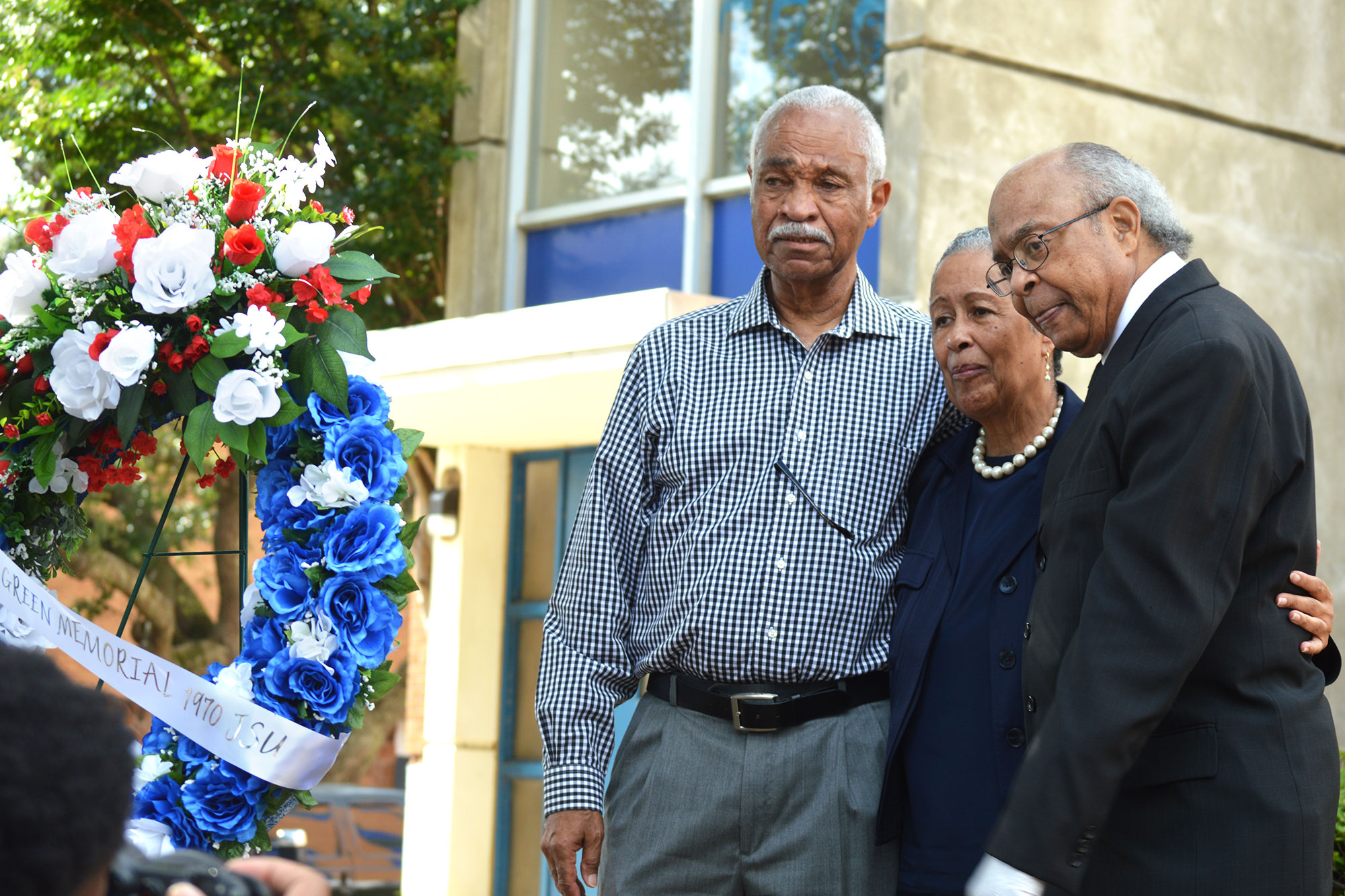
Jackson State University held a ceremony on May 14, 2024, commemorating the 54th anniversary of the 1970 police killings of Phillip Lafayette Gibbs and James Earl Green.
Gibbs was a 21-year-old married father and JSU pre-law student at the time. Green, a 17-year-old Jim Hill High School student-athlete, was walking home from his part-time job in the early morning hours when the rain of gunfire killed him.

Dale Gibbs, Phillip Gibbs’ widow, spoke briefly at the ceremony before JSU President Marcus L. Thompson presented the family with a doctorate degree in his honor.
“Phillip and I married at a young age and I was widowed at a young age,” Gibbs said.
She said her husband was on campus that night to pick up his sister who was also a JSU student at the time. Unbeknownst to both Phillip and Dale, she was pregnant with their second child on the night he was killed.
“I looked back at the spot where they say he took his last breath and I couldn’t help but shed a few tears,” she continued. “When you lose a husband in that manner, it’s just horrible. He didn’t get to raise his children… that’s just not right. No one ever paid the price for killing my husband and my children’s father.”
Thompson called the incident “a senseless loss of two young lives.”
James Lap Baker, along with fellow JSU alumni Gailya Porter and Quilly Turner laid the wreath commemorating the slayings of Gibbs and Green at a ceremony on Tuesday, May 14, 2024.
“They said there was a sniper (at Alexander Hall),” Baker, who was about 10 feet away when the shooting happened that night, told the Mississippi Free Press.
Baker said the claim never made sense to him because Green’s body was found on the opposite side of the street in front of B. F. Roberts Dining Hall, not where police claimed they were firing at a sniper.
“No sniper was on the first, second, third, fourth or fifth floor,” Baker said. “(The police) came with a mission to kill and that’s what they did,” he continued.

Baker denies historical retellings that claim the protests were over the Vietnam War. “There were only a few people protesting the Vietnam War, a few. That’s what Kent State was doing,” Baker said, referring to the Ohio university where the Ohio National Guard opened fire on student protesters who opposed the Vietnam War, killing four and wounding nine on May 4, 1970—11 days before the JSU shootings.
Instead, he said, JSU students were frustrated about the racial oppression that was happening close to home.
“Things were happening every year. In 1967, Benjamin Brown was shot and killed,” he said.
Civil-rights activist Medgar Evers was assassinated outside his home in Jackson four years before Brown’s death.
In 1964, a white motorist driving on Lynch Street rammed their vehicle into JSU student Mamie Ballard, breaking her leg.
Each incident, along with others, compounded tensions and culminated with the killings of Gibbs and Green on May 15, 1970.
‘An Unreasonable, Unjustified Overreaction’
No one has ever been held accountable for the shooting deaths of Phillip Lafayette Gibbs or James Earl Green.
At the time, the country was embroiled in antiwar protests over the Vietnam War, racial oppression and human rights. Both the Civil Rights Movement and the Black Power Movement were ongoing.
In June 1970, President Richard Nixon established the President’s Commission on Campus Unrest, which held an investigation into a series of student protests, including what happened at Jackson State University.

The commission concluded that the police attack was “an unreasonable, unjustified overreaction” and debunked the officer’s claims that they began firing in reaction to a sniper at Alexander Hall.
In 1974, the New Orleans-based 5th U.S. Circuit Court of Appeals ruled that the officers had overreacted but they could not be held liable for the two deaths that resulted from the gunfire.
Civil-rights attorney Constance Slaughter-Harvey led a 10-year civil lawsuit against the City of Jackson and the State of Mississippi on behalf of the families of the victims and survivors of the shooting.
But in 1982, the U.S. Supreme Court refused to hear the case.
JSU alumnus James Lap Baker reflected Tuesday on what today’s students should take away from the tragedy. “Stay together. Not just students, but all Black people,” Baker said.
“Know your history. We’ve got to know where we came from in order to have a better understanding of where we are and a vision for where we’re going.”