
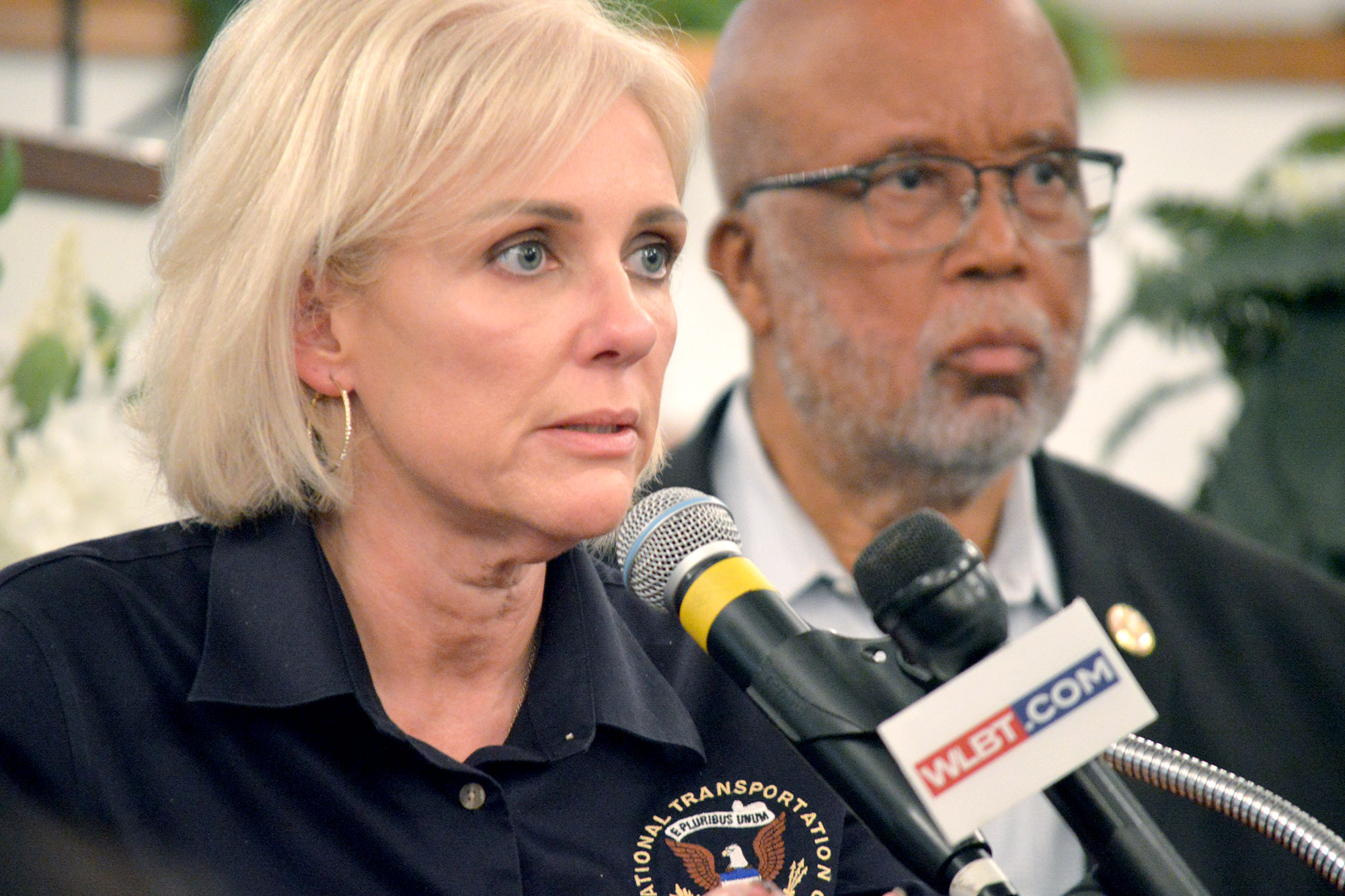
JACKSON, MISS.—Months after 82-year-old Clara Barbour died in a home explosion on Bristol Boulevard the morning of Jan. 24, 2024, South Jackson residents are still concerned about the safety of the natural-gas pipelines in their neighborhoods. They expressed their worries to National Transportation Safety Board Chair Jennifer Homendy at a town hall at Greater Mt. Olive Baptist Church on April 24.
U.S. House Rep. Bennie Thompson, a Democrat whose district includes the Mississippi Delta and most of Jackson, hosted the event to allow residents to question officials directly about the NTSB’s ongoing investigation, the proper protocol for reporting a suspected gas leak and how the agencies communicate to handle a report.
Representatives from the NTSB, the Mississippi Public Service Commission, the Mississippi Department of Transportation’s Pipeline and Hazardous Materials Safety Administration and Atmos Energy were in attendance.
‘Our Entire Investigation Is About Saving Lives’
Although the NTSB, a federal agency headquartered in Washington, D.C., is commonly known for in-depth inquiries and safety recommendations after airline and rail accidents, natural-gas pipeline safety also falls under its jurisdiction.

Chair Jennifer Homendy and two investigators went over the agency’s Feb. 14, 2024, preliminary report, which documented what the agency found in the first 30 days of their investigation after the deadly South Jackson home explosion, which not only killed Clara Barbour, but injured her husband, Johnny Barbour.
“Our entire investigation is focused on one thing and that’s saving lives,” Homendy said on April 24. “Our sole mission is to prevent a tragedy from recurring. We investigate with that goal in mind. What happened? How did it happen and how do we prevent it from recurring?”
The initial report included information from Atmos Energy about two “non-hazardous” gas leaks the utility company found in the area near the explosions in November and December 2023. Neither of those leaks were repaired before Barbour’s death.
Those ‘non-hazardous’ leaks and Atmos’ record is now in question. Atmos has received some 41 letters of noncompliance from the Mississippi Public Service Commission since 2013, WLBT reported on May 9, 2024.
However, the agency has not yet said whether either of those gas leaks led to the explosion at Barbour’s home or the home on Shalimar Drive. “We still have a lot of work that we need to conduct and a lot of information that we need to collect as part of this investigation,” Homendy said.

Still, Rep. Bennie Thompson asked, “If we had not had the explosions, how long would those leaks have gone on without being repaired?”
Atmos Energy has yet to explain why it initially deemed the gas leaks its technicians discovered in November and December 2023 near the locations of both explosions as “non-hazardous.” However, the company’s website says that “leaks identified on the Atmos Energy transmission and distribution systems are investigated and graded in accordance with our repair procedures, which meet or exceed the requirements of the state or federal regulation.”
During the town hall, residents also voiced concern over what they perceived as a lack of transparency from Atmos Energy over the company’s infrastructure fixes in the area in the weeks following Barbour’s death. Trucks from several different pipeline companies lined the streets of South Jackson as workers dug massive holes in residents’ front yards in efforts to upgrade natural-gas pipelines.

Atmos Energy Vice President of Public Relations Robert Morgan III previously said at a different town hall meeting on Feb. 7, 2024, that after the explosions, Atmos Energy accelerated some of the projects that the company had formerly deemed “non-serious” and had scheduled to be completed at a later date.
“We monitored our system and made the decision to accelerate leak repairs and to accelerate infrastructure replacement programs. This is work that had already been planned,” Morgan said on Feb. 7.
Residents Question Responses To Gas-Leak 911 Calls
It could take up to two years before the NTSB completes its investigation into what caused the home explosion that killed Clara Barbour and a second explosion that happened three days later at a vacant home about a mile away on Shalimar Drive, NTSB Chair Jennifer Homendy said in Jackson, Miss., on April 24.
But residents gathered at the town hall meeting at Mt. Olive Baptist Church questioned how the Jackson Police Department, state officials and Atmos work together to address 911 calls about suspected gas leaks.
Mississippi Public Service Commission Economic Development Specialist Jason Clark read a prepared statement and said their team spoke with residents during an initial investigation in the days following Barbour’s death.

The Public Service Commission is tasked with regulating and monitoring the activities of utility companies throughout the state. Clark attended the meeting in the absence of Central District Commissioner De’Keither Stamps.
“During our investigation, as we were actually out there with Atmos, there were people walking down the street who actually smelled gas and nobody said anything. Nobody was calling,” Clark said.
He said active participation from residents could help prevent incidents like Barbour’s death from happening again. “If you smell gas, please, we can’t stress it enough, call 911,” he said.
But JPD Assistant Chief Vincent Grizzell presented documents he said showed that his department had received over 285 different 911 calls from people in Jackson reporting that they smelled gas in the year before Barbour was killed.
“Since Feb. 22, 2023, we had over 285 calls for service for gas leaks,” he said on April 24. “We’re not the experts (on gas leaks) but we do respond. Jacksonians had been calling from Feb. 22, 2023, all the way until the 17th of this month. 285 (calls). All different times of the day.”
Grizzell said officers and fire investigators responded to all but 11 of the calls, but he added that they need more training in responding to gas leaks and help creating a policy to ensure calls for gas leaks reach the proper channels.
But it is the Jackson Fire Department’s policy to call Atmos after they respond to a call of a suspected gas leak, he added.

Atmos Energy Vice President of Public Affairs Robert Morgan III chimed in, saying that it is within the company’s policies and procedures to respond to every call they receive about a suspected gas leak.
“If we get a phone call, we’re going to respond, point blank period. It’s our policy that if you do call, we will respond,” Morgan said. “All of the calls that come to us, we respond. That’s what we do.”
Morgan said he’s attended a number of town halls since the home explosions in January and that the company will do better about communicating with the public.
Homendy reminded the audience that once the NTSB has concluded its investigation, the agency will not enforce fines or penalties on any company or agency that may be at fault. As with all incidents they investigate across the country, they only serve to figure out what happened and issue safety recommendations that could prevent a similar situation from happening again.
But she did say that following a variety of accidents around the country, the NTSB’s safety regulations are typically enforced voluntarily.
She encouraged residents to keep asking questions of her investigators, state officials and Atmos Energy. “You deserve transparency. Demand it. You need to know what’s happening in your community,” Homendy said.