



JACKSON, Miss. — Mississippi’s new ban on diversity, equity and inclusion programs in public schools and universities is on hold after a judge temporarily blocked it.
U.S. District Judge Henry Wingate approved the request for a temporary restraining order brought by a group of plaintiffs, including the Mississippi Association of Educators.
The ACLU of Mississippi, which represents the plaintiffs, said in a statement that the new law imposes the “preferred views” of Mississippi’s state government on students, educators and families, violating the First and Fourteenth Amendments.
“We are fighting to protect the constitutional rights of teachers and students to share ideas and to receive and exchange knowledge,” the statement said. “We look forward to our day in court.”
The temporary restraining order will stay in place until Wingate rules on the plaintiffs’ request for a preliminary injunction, a longer-term order that would prevent the law from being enforced while litigation plays out in court.
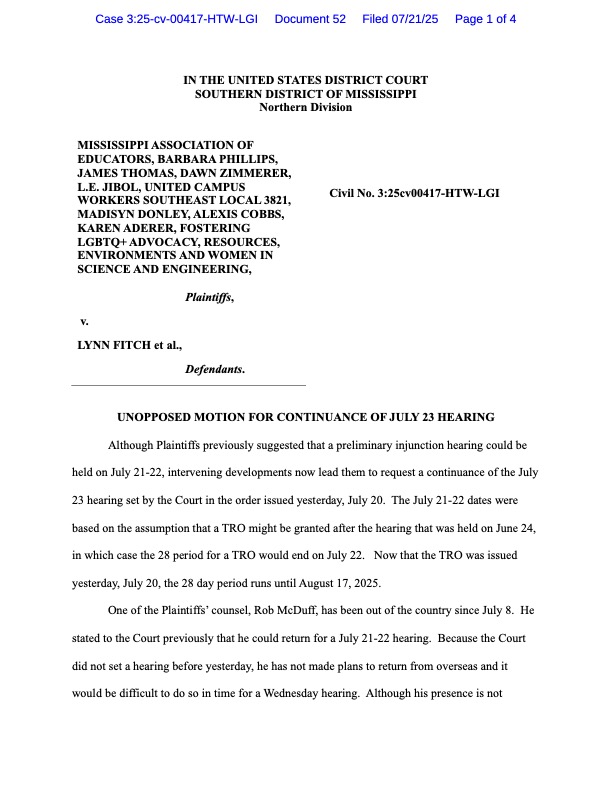
The court filing says that the judge imposed the temporary restraining order on July 20, beginning a 28-day period that goes until Aug. 17. The ACLU of Mississippi said Wingate’s order is a “critical first step.”
The law, which the Mississippi Legislature approved and Gov. Tate Reeves signed in April, prohibits Mississippi public schools and institutions of higher learning from teaching, creating or promoting diversity, equity and inclusion programs. The Republican-backed law also bans schools from requiring diversity statements or training during hiring, admission and employment processes in educational institutions.
Public institutions are also not allowed to teach or “endorse divisive concepts or concepts promoting transgender ideology, gender-neutral pronouns, deconstruction of heteronormativity, gender theory (or) sexual privilege,” the law says.
The legislation, House Bill 1193, would prohibit requiring diversity statements or training in hiring, admission and employment processes at educational institutions.
“HB 1193 is the latest in the attack on truth and free expression across our country,” said Amir Badat, a civil rights and racial justice attorney based in Mississippi, said when the coalition, including him, filed the lawsuit in June. “Nowhere is it more important to confront our history and our present-day realities than in Mississippi. When our teachers are afraid to teach, and when our students are banned from learning, we cannot progress as a state, a country, or a society. This lawsuit aims to protect free expression, open exchange of ideas, and truth-telling in our educational institutions.”
The complaint said the Mississippi Legislature is censoring “certain disfavored topics and ideas” and banning schools from teaching about “slavery, the Civil War, discrimination in the past and present, the civil rights movement, the women’s suffrage and women’s rights movements, the LGBTQ rights movement, and many other aspects of American life and life throughout the world.”
Higher education institutions in the state began making changes to their diversity, equity and inclusion policies and departments almost a year ago amid pressure from the state auditor. At the time, candidate Donald Trump’s presidential campaign promised future policies that would eliminate DEI programs.
In March, Mississippi State University began canceling programs, renaming campus buildings and changing website nomenclature in response to both state and federal laws.
The Mississippi Institutions of Higher Learning Board of Trustees and the Mississippi Department of Education Board adopted policies in June to comply with the law as part of the mandatory process outlined in the legislation. The law requires both boards to establish a complaint process and method for investigating alleged violations. Under the law, schools found to be in violation could lose state funding until issues are corrected.
In his ruling, Wingate cited instances in which the law is already having an impact as part of his motive for siding with the plaintiffs and temporarily pausing it. Faculty members at Jackson State University have been instructed not to discuss gender theory or systemic racism, he wrote.
“Suppressing constitutional speech through vague prohibitions and the specter of financial retribution does not serve the public good—it undermines it,” the ruling reads.
The bill’s sponsor, Rep. Joey Hood, a white Republican from Ackerman, defended the legislation against accusations that it infringed on free speech.
“We’re not going to restrict anyone’s freedom of speech because that’s guaranteed by the Constitution of the United States of America,” Hood said during the legislative session on Feb. 5. “There’s also an exception with this bill with regard to any violations of free speech. That’s not what it’s about. What it’s about is these institutions that are requiring these kinds of divisive concepts as part of an admissions process or being part of that school. Basically, we’re outlining what the divisive concepts are. We’re not going to mistreat anybody on the basis of race, sex, color, gender—any of those things that I outlined.”
The plaintiffs requested a continuance for the hearing, which was set for July 23, for some time between July 28 to Aug. 15 because some of the plaintiffs’ counselors and witnesses would not be available on July 23. Wingate granted the plaintiffs’ motion and set the hearing for the potential preliminary injunction on Aug. 5.
The Mississippi Attorney General’s Office declined to comment on the pending litigation.